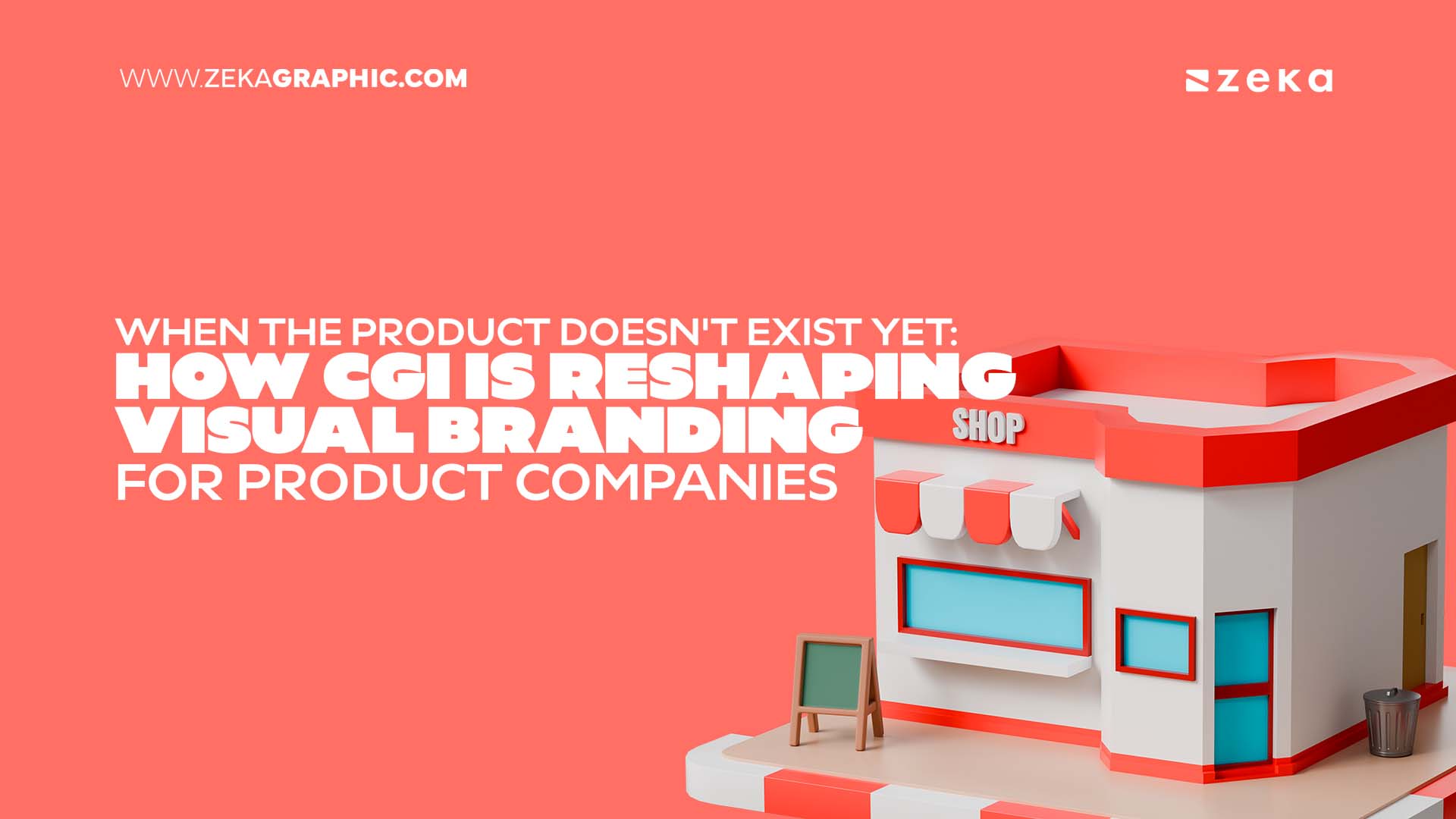
Brand identity work used to follow a predictable sequence: the client makes the thing, you photograph the thing, you build the brand system around the photographs. The product comes first. The visual language responds to it.
That sequence is breaking down. Increasingly, clients need a complete brand visual system — website, campaign, packaging, social — before physical product exists, often before manufacturing has even started. The product launch and the brand launch happen simultaneously, sometimes with the brand going out first to test market response.
The question this creates for designers is practical and immediate: what do you build the visual system around when there’s nothing to photograph? The answer, for a growing number of product companies, is CGI — computer-generated imagery that produces photorealistic visuals of a product from 3D models, with no physical object required.
This isn’t a niche workaround. It’s becoming standard practice across furniture, homeware, consumer electronics, and industrial product categories. And it has implications for how graphic designers think about brand visual systems, image direction, and the relationship between product and identity.
Advertisment
Traditional product photography has three constraints that CGI doesn’t share: it requires a physical prototype, it’s tied to a specific moment in time, and each variation requires a new shoot.
A furniture brand launching a sofa in eight colorways and four leg finishes needs thirty-two distinct product configurations photographed. At studio rates, that’s a substantial production budget — and if the product spec changes after the shoot, it’s mostly wasted. A design tweak to the arm profile, a new fabric added to the range, a decision to offer the piece in a different size: each change means going back to the studio.
With 3d rendering services, the product exists as a 3D model. Colorway changes, material swaps, configuration variants — these are adjustments to the model rather than new shoots. The brand can go to market with a complete image library covering every SKU before a single unit is manufactured. It can add variants after launch without rebuilding the visual system from scratch.
For graphic designers, this changes what the brief looks like. Instead of directing a photography session with a physical product, you’re art-directing a CGI production — defining the visual language, the lighting register, the environmental context, the level of abstraction in the imagery. The decisions are the same in kind; the production pipeline is different.
Here’s where things get interesting from a brand design perspective. In CGI production, material and texture aren’t just product attributes — they’re design variables that can be controlled precisely, repeatedly, and in alignment with a brand’s broader visual system.
Physical photography captures materials as they are, under the conditions of the shoot. The fabric looks slightly different on a cloudy Tuesday in the studio than it did in the approved sample. The wood tone shifts depending on the light temperature. These are minor variations, but they accumulate into visual inconsistency across a large image library.
Professional 3d model texturing services build materials digitally using physically-based rendering properties — the roughness, reflectance, surface microstructure, and color response of a material are all defined in the model. Once defined, they’re consistent. Every render of that fabric, in any lighting environment, at any scale, behaves the same way. The material is specified, not captured.
For brand designers, this is significant. If a brand has a specific material palette — a particular quality of matte surface, a defined wood tone, a precise metal finish — that palette can be built into the 3D assets and maintained perfectly across every image. The brand’s material language becomes as controlled as its color palette or typography.
This is a level of visual consistency that’s genuinely difficult to achieve through photography. It’s one of the less-discussed reasons why brands that adopt CGI production tend to have more coherent image libraries.
Advertisment
Lighting direction is one of the most powerful brand differentiators in product imagery, and one of the most commonly underdefined elements in creative briefs.
Think about how differently lit product photography reads across categories. High-end furniture brands tend toward soft, diffuse, natural light — overcast window light, gentle shadows, warmth that suggests a home rather than a studio. Consumer electronics often use clean, directional light with hard shadows that emphasize precision and engineered surfaces. Skincare and beauty lean into specific highlight behavior on reflective packaging. Each lighting register communicates something about the product and the brand’s position.
In CGI, lighting is built, not found. The direction, color temperature, intensity, softness, and number of light sources are all specified explicitly. This means lighting can be treated as a brand element — defined in the creative direction document alongside color palette and typography, then executed consistently across every image in the system.
What this means practically: when briefing a CGI production, lighting direction deserves the same specificity as any other brand element. ‘Warm and natural’ is a starting point. ‘Soft side light from the left at approximately 45 degrees, warm 3200K color temperature, secondary fill from a large diffused source on the right, no hard cast shadows’ is a brief that produces consistent results.
The discipline of specifying lighting precisely is something graphic designers already apply to other brand elements. Applying the same rigor to CGI lighting briefs is what produces image libraries that feel coherent rather than merely competent.
One of the recurring art direction decisions in CGI product imagery is how much context to show. The range runs from pure product on a clean surface — essentially a digital cut-out — to a fully styled room environment where the product is one element in a composed scene.
Each position communicates differently. A product on a clean white surface foregrounds the object itself: form, material, detail. It’s clinical, precise, useful for catalog and e-commerce where the buyer needs to evaluate the product clearly. A product in a styled environment communicates aspiration and lifestyle — it shows the buyer not just what the product looks like but how it might fit into a version of their life.
Most brands need both. The clean technical imagery for product pages and specification sheets, the styled environmental imagery for campaign and brand communications. In a CGI pipeline, both come from the same 3D asset — the model is rendered in a studio environment for one output and placed in a styled room scene for another.
The art direction decision is which environments serve the brand. A furniture brand targeting young urban buyers might render products in compact city apartments with specific styling cues. The same product line targeting a different demographic might be placed in larger suburban interiors with different material choices in the environment. The product is identical; the context tells a different story.
This is brand strategy expressed through image context — which is exactly the kind of decision graphic designers are equipped to make. The CGI pipeline just makes executing that strategy cheaper and more flexible than a full lifestyle shoot.
Briefing a CGI production is different from briefing a photographer in some specific ways that are worth understanding before you’re sitting in the kickoff call.
Advertisment
The practical conclusion for designers is this: CGI is not a specialist concern that only affects certain kinds of projects. It’s increasingly the default production method for product imagery across a wide range of categories, and it’s moving toward more categories as the technology becomes cheaper and the output quality continues to rise.
Designers who understand how CGI production works — what the inputs are, where the decisions live, how to brief it effectively — are in a stronger position when these projects come through. Not because they need to do the 3D work themselves, but because the creative direction, the brand alignment, and the art direction of the imagery are design work. That’s your territory regardless of how the images are made.
The product may not exist yet. The visual system still has to. And understanding the production method well enough to direct it confidently is what makes that possible.
Advertisment
Pin it for later!
If you found this post useful you might like to read these post about Graphic Design Inspiration.
Advertisment
If you like this post share it on your social media!
Advertisment


Want to make your Business Grow with Creative design?
Advertisment
Advertisment