

Your brand perception is forming right now, in places you are probably not watching. The Google search result that shows up when someone types your company name. The 3.8-star rating next to a competitor’s 4.7. That LinkedIn page you haven’t touched since 2023.
People form opinions about your brand long before they visit your website – and those opinions decide whether they click on you at all.
That is exactly what we are sorting out here. We will show you why brand perception has become a real edge in competitive markets. You will also get 7 strategies to strengthen it, plus 4 methods to track whether it is improving.
Advertisment
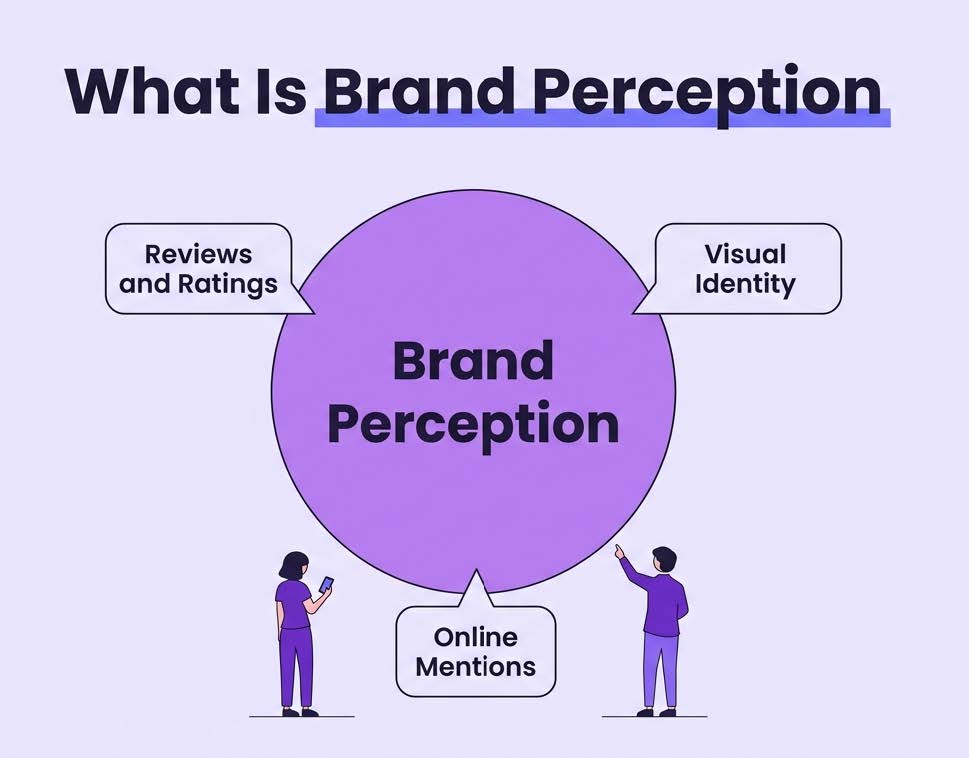
Brand perception is the opinion people hold about your brand based on everything they have encountered – your Google listing, your reviews, your social profiles, what a friend said about you. It is shaped by direct interactions and secondhand impressions.
The important part: it is not what you say about yourself on your About page. It is what someone believes about your brand image after they have Googled your name and spent 30 seconds looking at the results.

Brand perception used to be a big-company concern – something Coca-Cola and Nike thought about. Today, a 4-person design studio and a publicly traded agency show up in the same Google results. The one that looks more credible gets the click.
A $99 product from a brand with strong reviews and a polished market presence outsells a $79 product from a brand nobody recognizes. That is not a theory – it happens all the time in buying behavior.
Perceived quality influences buying decisions before product comparisons happen. 68% of shoppers will pay more for products from brands they trust. The first 10-15 seconds spent looking at your search results and reviews are enough for people to make up their minds.
And they are already starting to favor your brand by the time they reach your pricing page. Strong brand perception also increases customer loyalty and makes people more likely to return after their first purchase.
Someone who arrives at your site already thinking “I’ve heard of these guys, they seem solid” is a completely different visitor than someone who clicked a random search result and has no context about who you are.
The first person might convert from a single landing page. The second person needs testimonials and case studies. Probably a product tour and a follow-up email too. Positive brand perception gets people on your side before your website even loads and increases customer lifetime value because trust was established early.
“You should check out X, they’re good” – that recommendation happens because someone has a positive impression of X. And often, they are not even a customer. They read an article that mentioned X. They noticed X had strong reviews on G2. They liked the logo, and the website looked professional.
All of that formed a consumer perception that was strong enough to pass along in customer conversations. The referred person shows up already warm, which makes them easier to convert than any paid click you would buy from Google or Meta.
Two SaaS tools with nearly identical features and pricing. One has industry mentions and a founder who is on LinkedIn. The other has a logo that was made in Canva and has zero reviews anywhere.
Same product. Completely different outcome in the buyer’s mind. The first one gets shortlisted. The second one gets passed over. Brand perception is the tiebreaker when the actual product doesn’t create an obvious distance between competitors. Over time, this compounds into brand equity and brand value that competitors can’t easily copy.
Advertisment
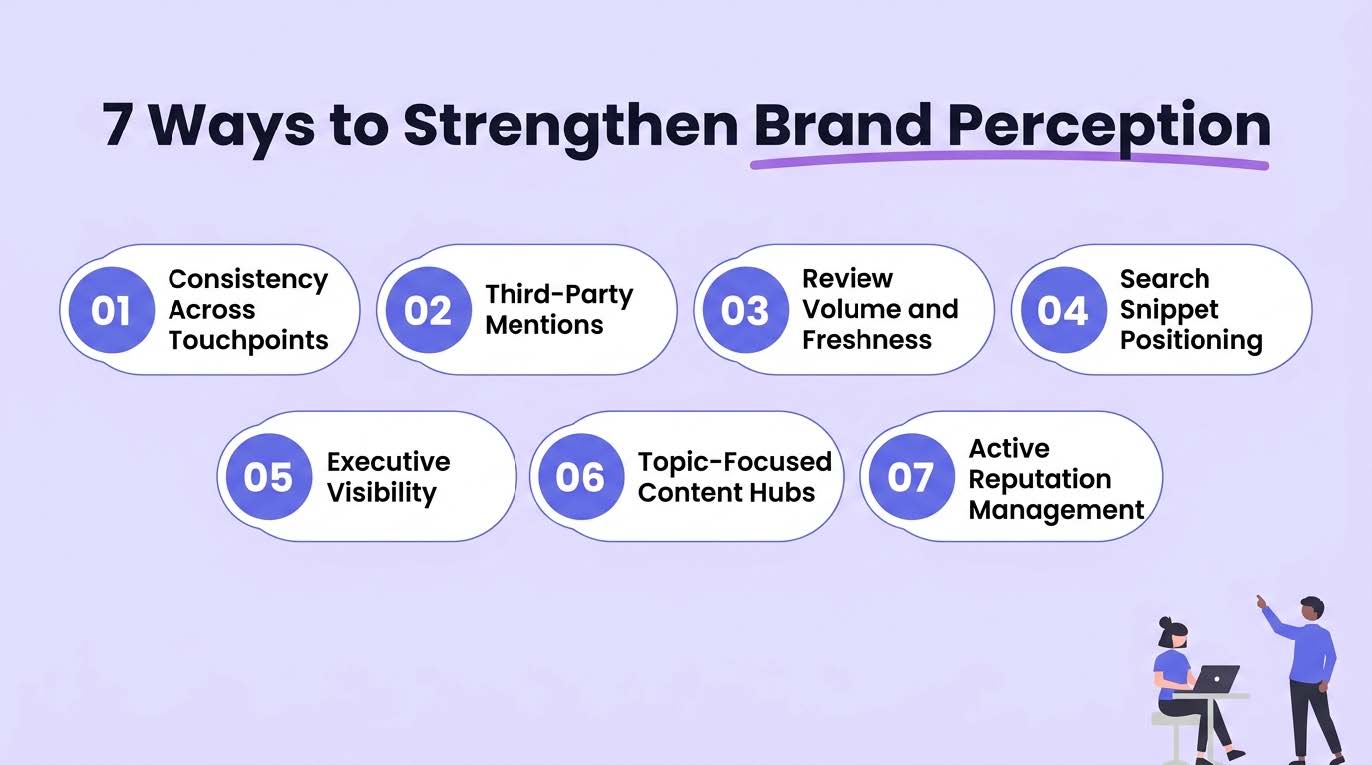
Every tactic in this section targets what happens outside your website. These are all pre-click brand perception signals – the things people see and evaluate before they have interacted with a single page on your site.
Your brand appears in more places than your website. Google Business Profile. LinkedIn. Instagram. Directory listings. Email footers. Brand identity elements should look the same everywhere people encounter your business. This helps people understand your brand personality faster.
Consistent brand presentation across platforms can increase revenue by up to 23%. But if the logo on your LinkedIn page is a version you stopped using two years ago, or if your colors are slightly different on every platform, people notice that even if they can’t point out why something looks wrong.
Pro Tip:
Search your company name on Google Images. Most businesses never do this. But image results become part of brand perception. Old event photos, outdated team headshots, low-quality graphics, random images pulled from third-party sites – they all can create a completely different impression than the one your brand is trying to communicate.
Review the first few rows of image results every quarter. Replace outdated visuals on important profiles and update images attached to high-traffic content. When people search your brand, the images associated with it should look like the company you are today… not the company you were 3 years ago.
When someone sees your brand name mentioned on sites they already trust, that changes how they perceive you before they have even visited your website. You didn’t write it. You didn’t control it. And that is exactly why it counts. A mention on a credible third-party site changes how consumers perceive you more than 100 social media posts on your own account.
Reviews are probably the most visible quality perception signal for any business that sells online. Volume matters – 12 reviews look different from 200. But freshness matters just as much for perception shift. A business with 200 reviews but none in a year raises questions. One with 85 reviews and 10 in the past 30 days looks active.

The title tag and meta description in Google are the first pieces of text someone reads about you when they search for your brand name or a keyword you rank for.
If your search presence doesn’t live up to your brand promise, people notice the disconnect. And you have wasted the one pre-click opportunity to tell people who you are if your homepage title says “Home – Your Brand Name” and the description is auto-generated or blank.
Pro Tip:
The challenge is that a brand guide only helps if people actually use it. In many companies, the latest logo files are in one folder. Brand guidelines are somewhere else. Marketing templates are stored in a completely different location. Over time, employees start using outdated assets simply because they are easier to find.
Use the ShortPoint intranet page design tool to solve that problem by creating branded SharePoint intranet pages that make brand resources easier to access. Instead of sending employees through multiple folders and document libraries, teams can create centralized brand hubs where logos, guidelines, templates, and approved assets are organized in one place.
People connect way more with people than they do with company logos. A founder who shows up in podcast episodes and gets quoted in trade articles gives the brand a face. And that personal credibility transfers to the company.
Scattered blog posts on random topics don’t build brand perception. A concentrated collection of 15-20 articles on one specific subject does. A design agency with 20 posts covering brand identity – including color palettes and typography – reads as an authority on that subject.
A prospect who encounters three of those articles in separate searches starts to associate your brand with that topic. That association forms entirely outside your website, in the search results themselves.
And that matters more than it used to, since 75% of people purchase online at least once a month. That means these search-driven impressions are now tied directly to buying decisions that happen regularly.
Brand perception comes from what you put out and by how you respond to what comes back. A negative review left unanswered for 6 months shows that the brand either doesn’t notice or doesn’t care. And that creates a negative perception surprisingly quickly.
The same review with a thoughtful response tells a different story. Users form a first impression of a brand in just 50 milliseconds. But ongoing sentiment decides whether that impression gets stronger or fades. In fact, the strongest brands go beyond this and focus on creating emotional connections.
Pro Tip:
The hard part is making sure someone actually fixes reputation issues. A team notices that negative reviews keep mentioning slow response times. Another month passes, and the same complaint keeps showing up because nobody was accountable for improving it.
This is where an OKR platform like the OKRs Tool becomes useful. It lets you turn recurring reputation problems into measurable objectives with clear ownership. For example, if customer reviews consistently mention support quality, that feedback can become a formal objective with key results tied to response times or customer satisfaction improvements.
That creates a direct connection between what customers are saying publicly and what internal teams are working on every week.
Advertisment

Brand perception improvements are hard to feel in real time. You need consistent tracking to understand brand perception accurately. Here are 4 methods for brand perception measurement.
How many people search your brand name on Google says a lot about awareness and customer perception. If that number is growing, more people are noticing you and holding your name in mind.
Google Search Console shows this perception data for free – filter queries containing your brand name and look at the trend over 6-12 months. A flat line tells you that your visibility work isn’t registering yet. An upward trend tells you it is.
Your average star rating is a single-point snapshot. The trend of that rating over the last 90 days is the actual signal. A steady 4.6 for a year means a consistent brand perception. A drop from 4.6 to 4.2 in the last 3 months means something changed in the customer experience.
Track this customer data monthly on Google and on whichever industry platform your buyers use most. For B2B, that is usually G2 or Clutch. For B2C, it is Trustpilot or Yelp.
Five questions, sent to anyone who bought or signed up in the last 60 days. In the brand perception research, ask:
That third question in this market research is where you get a more genuine understanding of whether your brand is creating a negative brand perception or a positive perception. You can also supplement surveys with small focus groups to get more detailed customer feedback.
You know your brand perception is on track when the words people pick match the positioning you are going for. But if people describe you in a completely different way than you would, there is a perception gap between what your brand represents and what people are getting.
Social media monitoring helps you catch sentiment changes before they become larger problems. Brandwatch and Mention track what people say about your brand on social media platforms when they are not talking to you directly. Reddit threads. Twitter/X posts. Industry forum comments.
The tone of those unprompted mentions – enthusiastic, neutral, frustrated – is brand perception in its most honest form. A company getting mentioned with genuine enthusiasm has a stronger perception than one that only gets mentioned when someone has a complaint. You see the difference between those two in conversion rates and in how often people recommend you to others.
Invest in style guides as a proven method for expanding corporate revenue. Graphic standards are not merely decorative elements for creative teams. Around 77% of corporate marketers create a powerful identity to support business scaling. Strong layout systems shorten the sales cycle by answering buyer questions visually.
When teams use a unified visual style, sales materials require fewer revisions. Faster content production means marketing campaigns reach target audiences ahead of schedule. Scalable design frameworks save labor hours and increase total profit margins.
Here are 3 examples that show how different brands handle perception and why it works for them.

With Custom Sock Lab’s athletic crew socks, the product itself strengthens the perception buyers form about what it stands for. Many promotional product companies focus more on surface design, while this approach keeps the message embedded in the product experience itself.
The company presents them as athletic gear designed for teams and organizations that want their branding integrated into something people actually wear during activity. That matters because it changes the perception from “promotional giveaway” to “performance apparel.”
A big part of that comes from how Custom Sock Lab showcases the product. Instead of using customization as an add-on feature, the company has built the whole experience around it.
Visitors immediately see logos woven directly into the socks rather than printed onto them afterward. That creates a perception of permanence and quality before a buyer ever evaluates pricing.
The lesson here is simple. Custom Sock Lab shapes brand perception by controlling what buyers focus on first. Rather than leading with product specifications, it leads with visual proof that the customization is part of the product itself. That approach helps the company look more premium and more specialized than competitors selling similar products.

Spotminders tracking cards take a completely different approach. Their brand perception strategy is built around anxiety reduction, not customization or aesthetics.
The product is positioned around a very specific situation: losing everyday items like wallets or cards. Instead of broad lifestyle framing, their product page focuses heavily on use-case realism. The messaging repeatedly anchors itself in scenarios like misplaced wallets and travel situations.
The tracking card is presented as something almost invisible in function but extremely visible in outcome. The visuals show the card inserted into wallets and card holders without drawing attention to design details. That reinforces a key perception – this is not a tech gadget you manage. It is something that prevents loss.
They also structure credibility through constraint-based messaging. They highlight limitations and boundaries clearly – battery-free, no charging cycles, passive tracking. This creates a perception of reliability through simplicity rather than capability overload.
Spotminders builds perception through predictability. You know exactly what will happen after purchase, and that clarity is what drives confidence.

The brand perception strategy of the Uproas TikTok agency ad account solution is built on access, not product clarity or utility framing.
The service is structured around a specific idea: not everyone should have direct access to TikTok agency accounts, and that limitation is part of the value. Uproas frames it as managed access to a restricted channel that affects performance outcomes like ad scaling and account stability.
Their service pages focus heavily on operational language rather than marketing language. They talk about account setup structure and how accounts are maintained, rather than just what results you can expect. This shifts perception from “service provider” to “system operator.”
The page structure repeatedly reinforces that the service is not just account provisioning but ongoing management of something that directly impacts advertising performance. That framing changes how users perceive risk. The focus shifts to how controlled the setup process is.
Uproas builds perception through controlled restriction. The fewer assumptions the user has to make about how it works, the more confident they feel about the system behind it.
Advertisment
Every tactic in this article targets what happens outside your site. The brands that get clicked more and trusted faster are the ones that paid attention to how they look from the outside.
Different people perceive the same brand differently depending on where they encounter it. So, start with brand consistency across platforms. Get your review volume and freshness up. Rewrite your search snippets. Those 3 moves change perception faster than anything else on this list.
At Zeka Design, I focus on how brands actually show up across every touchpoint that matters. That means shaping how your identity looks and stays consistent, whether someone finds you on Google or visits your social page. The goal is simple for me. I want your brand to be recognizable and trustworthy the moment someone sees it.
If you are at a point where your brand looks different depending on where people find you, or it just doesn’t feel like it reflects the level you are operating at, I’d be happy to help you fix that. Reach out to Zeka Design, and let’s talk about how we can make it look like it belongs where you want it to be.
Advertisment
Pin it for later!

If you found this post useful you might like to read these post about Graphic Design Inspiration.
Advertisment
If you like this post share it on your social media!
Advertisment


Want to make your Business Grow with Creative design?
Advertisment

Advertisment


