AI is utilized by product designers in every stage of their work including research, initial interface designs, prototypes, usability testing, documentation, and hand-off to developers. The most effective software solves specific problems occurring during the design process. This software helps to eliminate redundancy, expand the possibilities for exploring various options, or transition from the initial idea to its execution.
Advertisment
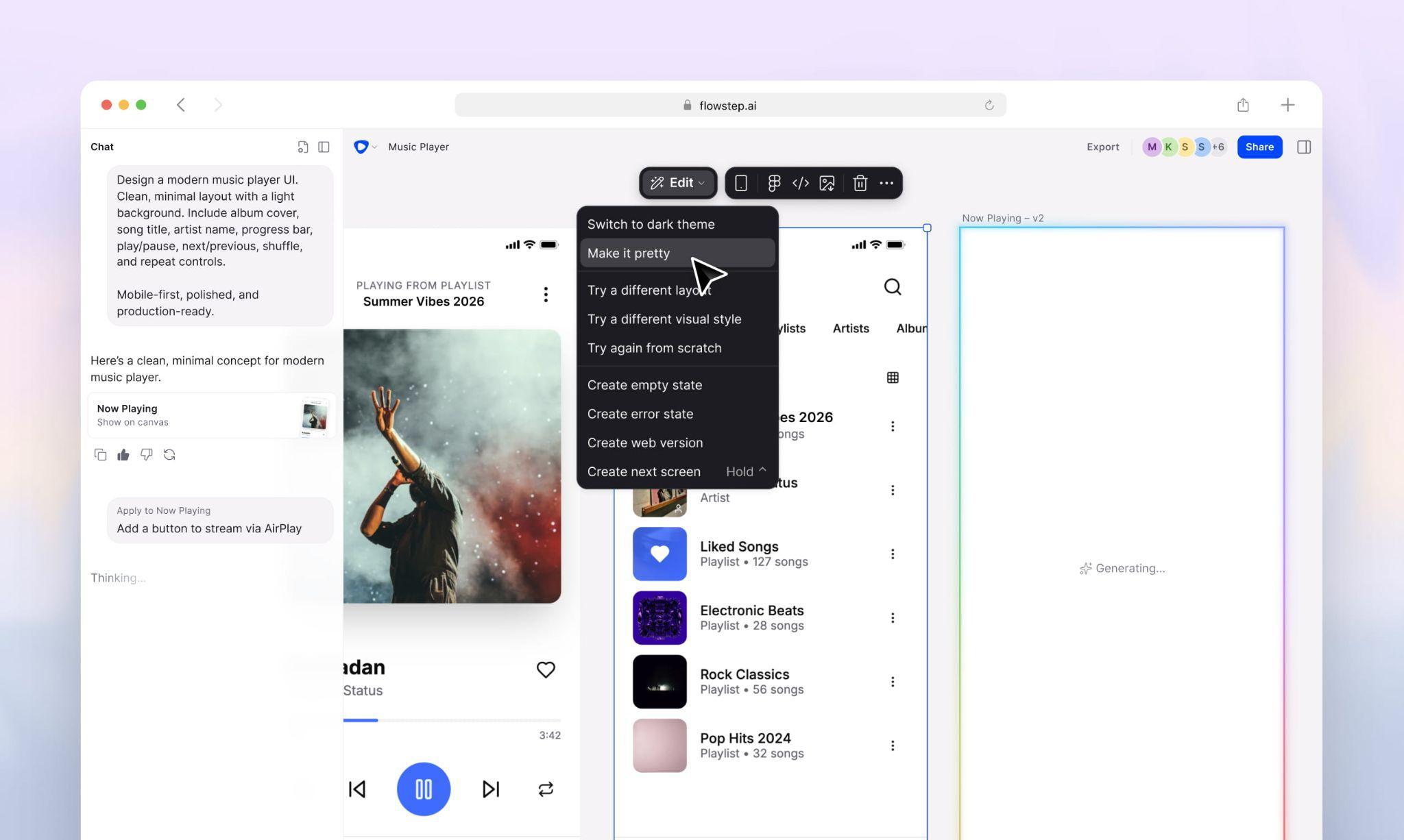
Flowstep is one of the most interesting tools for creating interface designs from a text prompt. A designer can start with a simple prompt and turn it into multi-screen UI. Flowstep generates not only UI but also production-ready code. It functions as an AI design engineer between interface design and implementation.
Main features:
Multi-screen UI generation from a single prompt
AI and manual editing on the same canvas
Copy-paste directly into Figma, no plugin needed
Start from prompts, screenshots, web links, or PRDs
React, TypeScript, and Tailwind CSS code export, plus MCP connection to coding agents like Cursor and Claude Code
Figma remains the central workspace for many product design teams. Its AI features can assist with generating interface content, renaming layers, organizing files, creating early layouts, and speeding up repetitive editing.
Its main advantage is continuity. Designers can use AI without moving away from the shared file where components, prototypes, comments, and design systems already live. This makes Figma suitable for teams that want AI support inside an established workflow.
Advertisment
Bolt.new helps turn written product ideas into interactive web applications. It can generate interface code, create common application structures, and update the result through conversational instructions.
For product designers, it is valuable during fast concept validation. A rough workflow can become a functional browser-based prototype that stakeholders can click through. It also gives designers a clearer view of how certain interface decisions behave in a real environment.
Framer AI makes an ideal solution for creating marketing pages, product launches, and website ideas that require interactivity. It can create a page layout from just a small description and then offer a visual editor for polishing it up.
This software fits perfectly if a product designer wants to release a concept quickly. Framer AI has support for responsive layouts, animations, editing and publishing of the content, thus bridging the gap between a static concept and a living page.

Midjourney is popularly employed for creating mood boards, art direction, illustration, campaign ideas, and visual references. The designers may apply Midjourney to experiment with the feeling of an intended brand or interface design prior to finalizing the visual design.
The best approach is usually to consider the generated visuals as reference materials which assist the designer in defining the texture, lighting, composition, or mood but do not determine the interface design.
Color exploration is what Khroma does. It studies the colors chosen by the user and creates color palettes, gradients, typography matches, and even samples that look like website interfaces.
It can prove useful for a designer who is unsure which color direction to choose, especially since he has already explored all the possible options.
The Miro AI tool enables automation in workshops and early stages of product thinking. Miro AI can create summaries of sticky notes, cluster ideas, make diagrams, create mind maps, and arrange brainstorming boards.
Product teams tend to gather too much data during discovery sessions. The Miro AI tool can help transform all that data into more meaningful topics and help designers uncover common issues, possible user flows, and questions to be answered.
Advertisment
Claude is useful for working with long product documents, interview transcripts, requirements, and research notes. It can summarize material, identify patterns, suggest user stories, and help structure complex information.
Designers can also use it to review interface copy, examine edge cases, or challenge assumptions in a proposed flow. The quality of the result depends heavily on the context provided, so detailed project information usually produces more relevant output.
Perplexity is useful in conducting market research and discovering competitors. It offers source-backed answers, making it easier to follow up on information from its original source.
A product designer can employ Perplexity to analyze typical trends in the industry, understand the needs of users, or look for other products that have solved a particular workflow problem. However, sources must be verified before conclusions are drawn from research.
Notion AI is very good in bringing together different pieces of information about projects in form of documentation. The software can do a summary of meeting minutes, rephrase product descriptions, make to-do lists, and extract decisions from lengthy pages.
The software excels most in ensuring that there is clarity throughout a project. Findings from research, design decisions, pending queries, and launch findings can all be kept in one workspace using the software.
Granola was built for taking meeting notes. Granola listens to what is being said, enhancing what is already being taken as notes to create a better document without the need for constant note taking.
This is important in design where it can be used for stakeholder meetings, user interviews, critique meetings, and design discussions.
Advertisment
Maze AI supports product research and usability testing. It can help create test plans, summarize responses, identify patterns, and organize findings from prototype tests or surveys.
It becomes especially important in cases where a group conducts multiple testing sessions. With AI, the response sorting process can be shortened, but the designer still needs to interpret the behavior and pick the results that should affect the product.
Loom AI improves asynchronous design communication. It can generate summaries, titles, chapters, and action points from recorded videos.
The designer may film an explanation of a prototype and then present to the developers and other stakeholders. In this way, no additional meetings would be needed and a basis for future discussions would be provided.
Cursor brings AI assistance into the code editor. Product designers with technical skills can use it to adjust front-end code, test interface ideas, inspect existing components, or build small prototypes.
It becomes especially handy in combination with tools generating structured code or passing design context through MCP. Designers are able to go from exploration through implementation while retaining more control over spacing, states, interactions, and responsiveness.
Advertisment
Choosing between these AI tools for product designers is a matter of identifying which particular part of the workflow brings the most friction now. Flowstep, Figma, Bolt.new, and Framer AI provide interface generation. Midjourney and Khroma contribute to the process of visual direction. Claude, Perplexity, Notion AI, Granola, and Miro AI improve research and planning. Maze AI, Loom AI, and Cursor aid in validation, explanation, and delivery of the final experience.
An efficient AI workflow does not require the use of all available tools at once. Usually, a selection of tools with specific functions gives better outcomes. A separate tool can do the research, another one generates interface flows and yet another helps to test or implement the designs. The designer retains control over the problem definition, assessment of generated output, and the inclusion into the product.
Advertisment
Pin it for later!
If you found this post useful you might like to read these post about Graphic Design Inspiration.
Advertisment
If you like this post share it on your social media!
Advertisment



Want to make your Business Grow with Creative design?
Advertisment
Advertisment