
Every business now carries a silent score — one that AI platforms, not customers, calculate. These invisible ratings pull from billions of data points and shape everything from loan approvals to enterprise partnership deals. This article examines how platforms build these systems, what signals they weigh, and why your reputation score increasingly matters more than any single customer review.
Advertisment
A business reputation score is an algorithmically generated measure of trustworthiness, calculated by analyzing customer reviews, social mentions, and dozens of other online signals. Platforms like Brandwatch, RepTrak, and Trustpilot each run their own proprietary models, typically producing scores on a scale — zero to one hundred, or zero to one thousand — that reflect how credible and consistent a business appears across the web.
Unlike a traditional credit score, which is largely static, a reputation score updates in near real-time as new reviews, mentions, and sentiment signals come in. That dynamism is both its strength and its risk: a single spike in negative reviews can move the needle quickly.
Research suggests businesses with reputation scores above 750 (on a 1,000-point scale) see meaningful improvements in customer retention. Those elevated scores reflect consistent positive feedback across platforms and strong trust signals over time. More practically, they’re the businesses that tend to win when buyers are comparison-shopping.
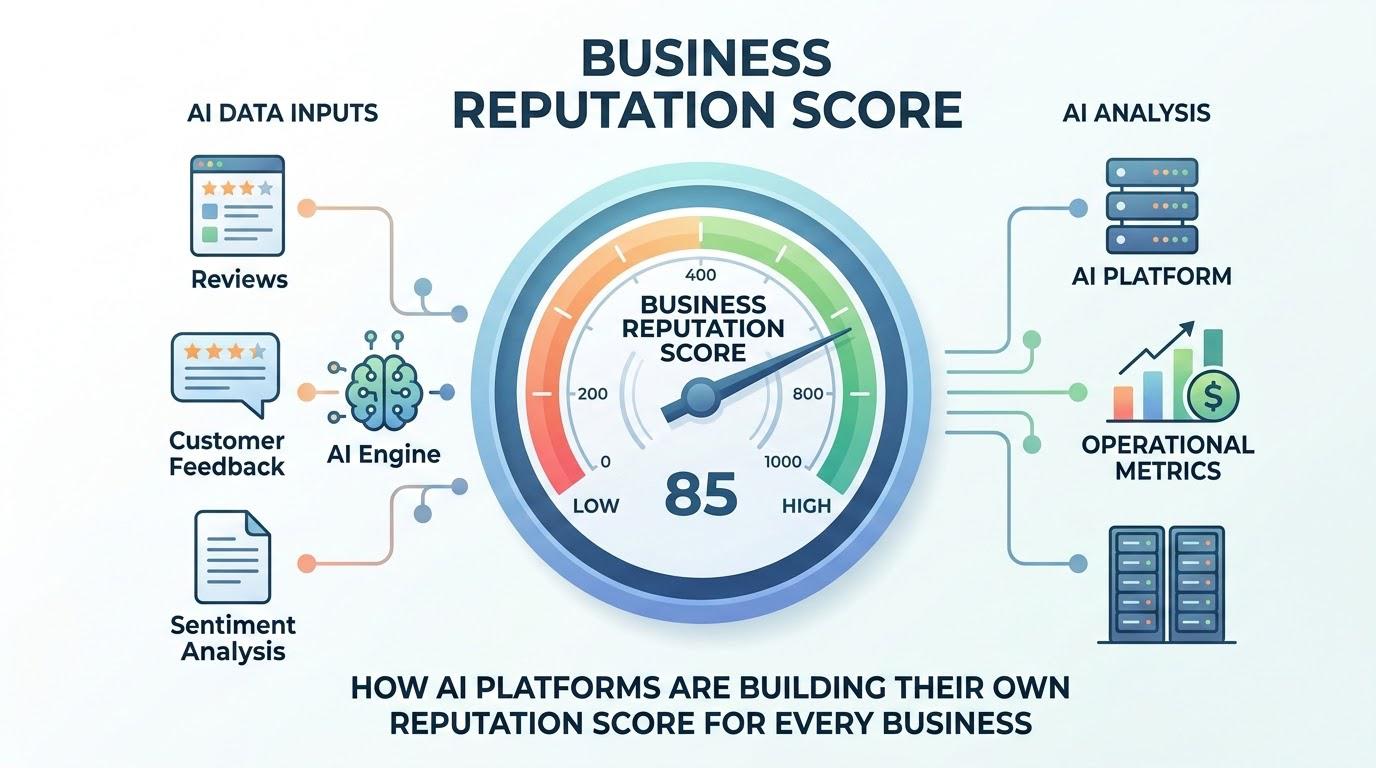
Not every platform measures a reputation score the same way. Semrush assesses businesses on a zero-to-100 scale derived from review sentiment across multiple sources. Trustpilot generates one-to-five-star ratings with built-in authenticity verification to filter out fake or incentivized reviews. The Better Business Bureau uses an A+ to F scale weighted across thirteen factors, including complaint resolution history, transparency, and customer service responsiveness.
Three use cases drive most of the demand for these scores:
A 2025 systematic review by H. Molavi, analyzing 104 studies published between 2000 and 2024, found that AI and machine learning are meaningfully improving the accuracy and predictive power of corporate reputation measurement — a sign that these scores are only going to carry more weight.
Advertisment
Reputation scoring platforms aggregate data from 150 or more review sources through a mix of web crawling and API integrations. The major inputs are predictable — Google Reviews, Yelp, TripAdvisor, Facebook Business Pages, Amazon, and Trustpilot — but the scale is worth appreciating.
Data Source | Approximate Review Volume | Access Method |
Google Reviews | 3.7B reviews | 1–5 scale ratings |
Yelp | 200M reviews | API access |
TripAdvisor | 859M reviews | Enterprise API |
Amazon Customer Reviews | 2.5B reviews | Product-focused data |
200M business pages | Graph API | |
Trustpilot | 228M reviews | RSS feeds |
Beyond these public sources, platforms layer in private datasets. Dun & Bradstreet maintains 330 million business records. Data aggregators like Acxiom and Epsilon contribute consumer profile data. BrightLocal and ReviewTrackers provide proprietary business listing intelligence. Government registries — Secretary of State databases across all 50 states — supply foundational verification data. Academic resources like the Stanford Review Corpus (2.8M entries) and the Yelp Dataset Challenge (8.6M reviews) are commonly used for model training.
Phone validation and purchase receipt matching help ensure data quality across both public and private sources. Without that verification layer, a reputation score is only as reliable as the reviews feeding into it.
The core of most reputation scoring systems is a transformer-based language model — typically BERT or RoBERTa — running sentiment analysis across reviews in multiple languages. These models process tens of thousands of words per second and achieve accuracy rates around 94–95% when trained on high-quality labeled data.
Three algorithmic approaches tend to appear in combination:
Beyond sentiment, platforms apply specific scoring techniques: TextBlob for polarity scoring (on a -1 to 1 scale), spaCy for named entity recognition across 500M+ documents, and TF-IDF for keyword extraction that surfaces the most meaningful terms in each review.
One of the more consequential design choices is temporal weighting. Most systems give recent reviews three times the influence of reviews older than six months. That means a business that was excellent two years ago but has slipped recently will see its score reflect current reality — which is fair for consumers, but a genuine risk for businesses that don’t actively manage their online presence.
Enterprise reputation scoring typically requires a minimum of 50 reviews before assigning meaningful scores, then monitors a layered set of signals:
These metrics feed directly into local SEO performance. Google incorporates trust signals into its local ranking factors, so a higher reputation score correlates with better placement in local pack results — making this both a credibility metric and a visibility one.
Platforms automatically flag businesses showing patterns that suggest manipulation or neglect. The common tripwires:
The final risk score typically weights authenticity (30%), consistency (25%), engagement (25%), and temporal patterns (20%). Businesses that fall below key thresholds often find themselves deprioritized in search results and excluded from automated vendor screening processes — sometimes without knowing why.
Firms like NetReputation work with businesses to diagnose exactly where their score is breaking down, whether that’s a spike in unresponded reviews, an authenticity flag, or a platform-specific gap — and build a strategy for addressing it systematically rather than reactively.
Reputation scoring isn’t one-size-fits-all. Platforms apply sector-specific weightings that reflect what actually matters in each industry:
These industry benchmarks matter because a score of 4.0 means something very different in healthcare than it does in software. Competitive positioning depends on understanding the right reference point.
Fortune 500 companies monitor 15,000+ brand mentions daily across 200+ platforms, with automated alerts for sentiment drops exceeding 15%. But reputation scores have moved well beyond brand monitoring.
Investment screening: Morningstar and other firms incorporate reputation scores into ESG evaluations of public companies, letting analysts assess business trustworthiness at scale alongside financial fundamentals.
Enterprise procurement: Organizations increasingly mandate minimum reputation score thresholds before approving supplier contracts. A low score can disqualify a vendor from even reaching the RFP stage.
Crisis management: Real-time sentiment monitoring can detect an emerging issue within hours. Early detection gives businesses a window to respond before a minor problem compounds into a serious reputational threat.
Recruiting: Glassdoor scores and similar workplace sentiment metrics influence candidate decisions significantly. Organizations with strong reputation metrics attract better applicants and spend less on recruiting.
These platforms are sophisticated, but they have real limitations worth understanding.
False positive rates in fake review detection run around 35% — meaning legitimate reviews sometimes get flagged, and some manufactured ones slip through.
Geographic and language bias is significant. When 80% of training data comes from English-language sources, model accuracy drops roughly 28% for non-English markets. That’s a meaningful gap for global businesses.
Data collection constraints add another layer of complexity. GDPR restrictions reduce EU review dataset sizes by approximately 40%. The 2023 Twitter/X API price increase (300% higher than previous pricing) forced many platforms to reduce their social monitoring coverage.
Adversarial gaming is a growing problem. As businesses learn how scoring algorithms work, some attempt to reverse-engineer them — flooding platforms with positive reviews or flagging competitors’ legitimate reviews as fake.
Regulatory requirements are tightening around automated scoring systems. GDPR Article 22 requires human oversight for automated decisions that materially affect individuals, and Article 5 mandates data deletion after the purpose is fulfilled — typically 2–3 years for reputation data. The EU AI Act classifies reputation scoring as high-risk, requiring comprehensive audit trails. CCPA gives California residents the right to opt out of data processing, with 45-day response requirements for data requests.
The consequences of getting this wrong are real. In 2023, Clearview AI was fined $50 million — not specifically for reputation scoring, but for unauthorized collection and use of biometric data without consent. The broader lesson is the same: building scoring systems on data people haven’t agreed to share creates serious regulatory and reputational exposure for the platforms themselves.
Advertisment
The next generation of reputation scoring will move well beyond text analysis:
The trajectory is clear: a business’s reputation score will function less like a marketing metric and more like a financial credit score — a fundamental measure of credibility that follows the business across every commercial relationship it enters.
Managing your reputation score proactively — monitoring it, understanding what’s driving it, and addressing gaps before they compound — is no longer optional for businesses that rely on digital visibility to grow.
Advertisment
Pin it for later!
If you found this post useful you might like to read these post about Graphic Design Inspiration.
Advertisment
If you like this post share it on your social media!
Advertisment






Want to make your Business Grow with Creative design?
Advertisment

Advertisment