Direct mail may seem like a relic in an era dominated by email, social media, and AI-powered advertising. Yet consumers haven’t lost their appetite for physical marketing. According to the 2025 ANA/DMA Response Rate Report, more than 70% of consumers engage with the mail they receive. Now, that’s a level of attention many digital channels can only envy!
Unlike emails that disappear with a click, postcards, brochures, and catalogs have staying power. They sit on desks, kitchen counters, and coffee tables, keeping your brand visible long after a screen goes dark.
But attention is still a rare commodity nowadays. That’s why strong branding is essential to direct mail success. In this article, we’ll explore the main types of direct mail campaigns and share practical examples of how branding can make them stellar.
Advertisment
Today’s direct mail advertising has gone digital behind the scenes, using customer data and analytics to target the right households and track campaign results. You can have the most beautiful design in the world, but if you send a luxury lawn care flyer to apartment renters, your conversion rate will be exactly zero.
So, just as in the digital world, the foundation of every successful direct mail campaign is an accurate, up-to-date mailing list. Then the printed materials (often personalized) are distributed via postal services or private carriers to specific addresses, respecting a very carefully chosen time interval. Nothing happens by sheer intuition anymore.
There are four classic formats marketers tend to use for direct mail: postcards, letters, brochures, and dimensional mailers. The best format for your campaign depends on your message, objectives, and target audience.
Let’s have a look at each:
Advertisment
A nice-looking postcard is the most cost-effective option for small businesses looking to reach a local audience. The format is straightforward, and if you’re using the USPS’s Every Door Direct Mail (EDDM) service, there’s no need for specific addresses, just a target area.
Businesses that depend on local visibility, such as home service providers, restaurants, retailers, or healthcare practices, often turn to postcards to stay top of mind in their communities. This is why branding is crucial: it makes the difference between your postcard landing in the trash can or on the fridge door.
Let’s take a home cleaning business as an example. As we’ve established, using EDDM for cleaning companies is the natural move because the service is in high demand amongst homeowners. But your design, timing, and branding make all the difference.
A clean visual identity, a straightforward message (“Take Back Your Weekend. Let Us Do the Scrubbing.”), and a small incentive (“$25 OFF Your First Whole-House Deep Clean.”) is enough to catch the receiver’s attention. Now, if you time your campaign for the spring and/or autumn cleans, your strategy is golden!
Used frequently for B2B marketing, non-profit fundraising, or highly personalized financial and insurance offers, letters mimic official correspondence. This alone boosts open rates, but if you want the receiver to actually read the message, branding has to do the heavy lifting.
The most famous and financially successful example of a company using an official letter format is The Wall Street Journal’s Two Young Men campaign. Written by legendary copywriter Martin Conroy in 1975, this single sales letter was mailed continuously for 28 years (until 2003) and generated an estimated $2 billion in subscription revenue.
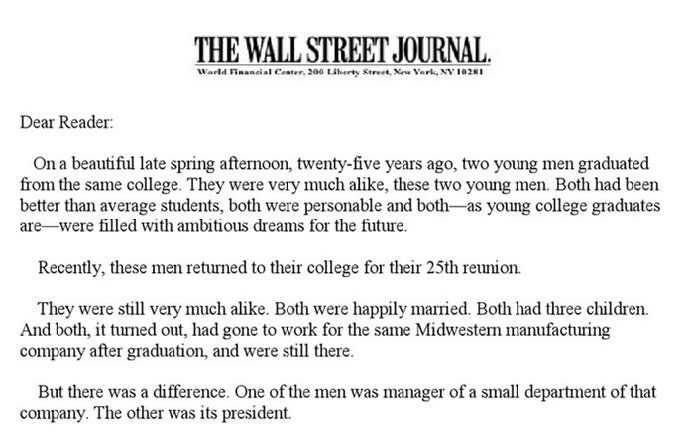
The main reason it was so successful is its tone. This letter did not feel like a loud advertisement. It was structured as a formal, two-page business letter sent in a classic envelope. It relied entirely on storytelling rather than flashy design or bold discount badges.
These are multi-page or folded sheets that provide ample space for storytelling, product features, and rich visuals. Brochures are great for businesses selling high-consideration products or luxury services that require a long decision-making process.
Through their design, brochures can tell a deep story, showcase multiple options, or overcome significant consumer hesitation. And IKEA is the best example of how to do this. For seven decades, the giant Swedish retailer relied on its iconic annual catalog and seasonal brochures as its primary direct mail engine.
They masterfully used brochures to build a brand promise of diversity, reliability, and flexibility, but also to drive both showroom foot traffic and online sales.
If you want to make absolutely sure your recipient will interact with your materials, you use dimensional mailers. These are high-end packages or boxes containing 3D items, product samples, or gifts. Because they physically stand out in a stack of flat paper, they boast nearly a 100% open rate.
Due to the high cost of production and parcel-rate postage, dimensional mailers are almost never used for mass-market consumer advertising. Instead, they are primarily deployed by B2B (business-to-business) companies, enterprise software firms, and high-value service providers targeting a very small, highly specific list of decision-makers.
Advertisment
While direct mail can be more effective at catching people’s attention, without proper branding and targeting, it can easily become generic junk mail. Brand assets like recognizable color palettes, premium typography, and sharp logos are crucial in helping receivers connect with the message and offer.
Advertisment
Pin it for later!
If you found this post useful you might like to read these post about Graphic Design Inspiration.
Advertisment
If you like this post share it on your social media!
Advertisment

Want to make your Business Grow with Creative design?
Advertisment
Advertisment